
PET Stitch-Bond Nonwoven vs. Needle-Punched Nonwoven for Automotive Wire-Harness Tape
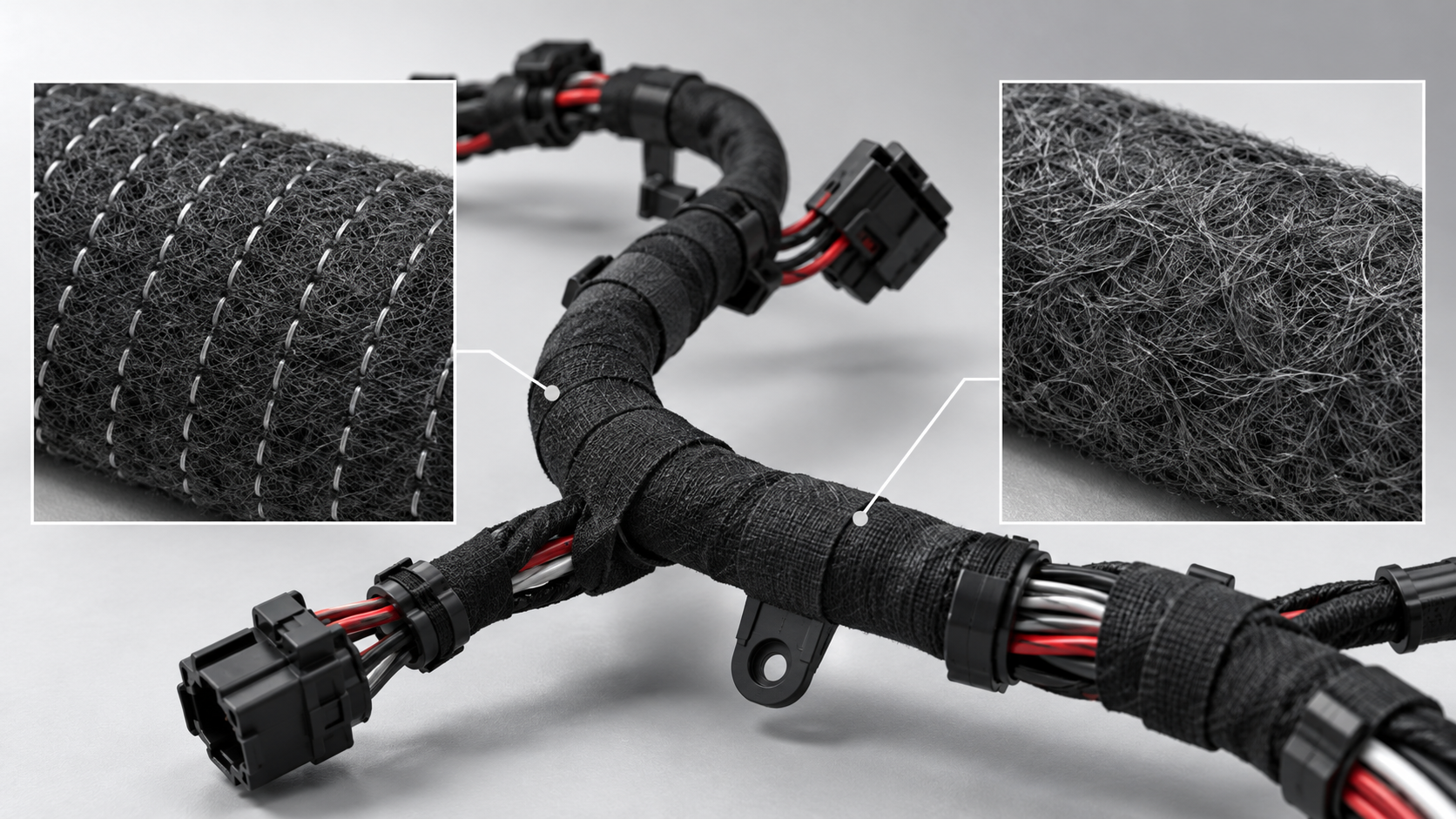
Choosing a backing material for automotive wire-harness tape is not simply a matter of selecting a fabric with the lowest basis weight or the highest tensile strength. The backing must work as part of a complete tape construction that includes the adhesive, coating process, slitting conditions and final installation method. It may also need to support requirements for hand tearability, noise reduction, flame retardancy, low volatile organic compound (VOC) emissions and dimensional stability.
PET stitch-bond nonwoven and needle-punched nonwoven are both used in textile-based industrial applications, but they are made differently and do not behave in exactly the same way. Neither structure is universally better. The correct choice depends on the tape design, the application position in the vehicle and the qualification requirements for the finished tape.
What Is PET Stitch-Bond Nonwoven?
Stitch-bond nonwoven is made by reinforcing a fibrous web with a regular stitching structure. The fiber web provides coverage and body, while the stitching construction helps control the fabric's strength, dimensional behavior and surface pattern. Polyester, especially PET, is widely used because it offers a practical balance of strength, processability and thermal stability for many industrial applications.
For automotive wire-harness tape, PET stitch-bond nonwoven is supplied as a backing substrate or carrier fabric. It is not a finished adhesive tape. A downstream tape manufacturer applies the selected adhesive system and then performs drying, winding and slitting according to the finished-tape design.
The stitch construction can be adjusted by grade. Basis weight, thickness, stitch density, fiber selection and finishing conditions all affect the final hand feel and processing behavior. This is why two materials that are both described as "PET stitch-bond nonwoven" may perform differently during coating or tape application.
What Is Needle-Punched Nonwoven?
Needle-punched nonwoven is produced by repeatedly passing barbed needles through a fibrous web. The needles mechanically entangle the fibers and consolidate the web without creating the regular yarn pattern associated with stitch-bond construction.
Needle-punched materials can be engineered across a broad range of densities and thicknesses. Depending on the fiber, web formation and needling conditions, they may provide loft, cushioning and acoustic absorption. They are used in many automotive, filtration, insulation and interior applications.
As with stitch-bond materials, the name of the process alone does not determine performance. Fiber type, basis weight, thickness, density, surface treatment and the adhesive system must all be evaluated together.
Key Selection Factors for Wire-Harness Tape Backings
1. Thickness and basis-weight consistency
Stable thickness and basis weight help the coating manufacturer control adhesive coat weight, drying and winding. A backing that varies excessively may create differences in tape caliper, roll build or unwind behavior.
Stitch-bond construction can provide a clearly defined reinforcement pattern and controlled directional strength. Needle-punched construction can provide different levels of density and loft. Buyers should compare actual production tolerances rather than assume that one process is always more consistent.
2. Hand tearability
Some harness-tape applications require installers to tear the finished tape by hand. Hand tearability depends on the backing construction, direction of tear, adhesive layer, finished tape width and manufacturing settings.
A stitch-bond grade can be designed for easier transverse tearing while retaining useful strength in the machine direction. However, this property must be confirmed using the selected backing together with the intended adhesive and finished-tape construction. A fabric-level observation does not automatically guarantee the hand-tear performance of the completed tape.
3. Noise damping and cushioning
Wire harnesses may contact vehicle panels or other components, creating vibration or rattling. Textile tape backings can help reduce noise, but the result depends strongly on thickness, density, compressibility and the final wrapping method.
Needle-punched nonwovens are often considered when loft and cushioning are important. Stitch-bond nonwovens can also be developed for noise-damping applications, particularly where a defined surface, controlled thickness and hand tearability are required. Qualification should be based on the complete tape and its installation position.
4. Coating compatibility
The backing must tolerate the tape manufacturer's coating, drying, winding and slitting process. Surface structure and porosity influence adhesive penetration and anchorage. Excessive penetration may increase adhesive consumption, while insufficient anchorage may affect tape integrity.
The correct balance cannot be selected from a fabric specification alone. Buyers should provide information about the adhesive chemistry, coating method, target coat weight, drying conditions and required unwind behavior. Trial coating is normally the most reliable way to confirm compatibility.
5. Flame-retardant and low-VOC requirements
Automotive programs may specify flame behavior and restrictions on emissions or substances. These requirements can differ by customer, vehicle platform, application position and test method.
Terms such as "flame retardant" or "low VOC" should therefore be tied to a specific grade and applicable test report. A supplier should not claim that every grade complies with every automotive standard. Before qualification, buyers should identify the exact test method, limit, specimen construction and reporting requirements.
6. Conformability and installation
The finished tape must wrap around straight sections, branches, connectors and irregular harness geometries. A very stiff backing may be difficult to conform, while an overly soft or extensible material may be harder to process consistently.
Hand feel is affected by the fibrous web, stitch construction, thickness and finishing treatment. Sample evaluation should include both coating trials and installation trials on representative harness geometries.
Practical Comparison
- Basic structure: Stitch-bond nonwoven uses a fiber web reinforced by a regular stitching construction; needle-punched nonwoven uses a fiber web consolidated through mechanical fiber entanglement.
- Surface character: Stitch-bond material has a defined stitch pattern that can be adjusted by construction and grade; needle-punched material has a more fibrous surface, with density and loft determined by needling conditions.
- Directional behavior: Stitch-bond material can be engineered for controlled machine-direction reinforcement and transverse tear behavior; needle-punched material depends on web orientation and needling and may be more isotropic in some constructions.
- Cushioning potential: Both are available in multiple thicknesses, while needle-punched material is often considered where loft and cushioning are important.
- Coating response: Both structures require trials with the intended adhesive, coating and drying process.
- Best selection method: Evaluate the specified grade with the intended adhesive and finished-tape process.
These points describe general construction tendencies, not guaranteed performance. The production specification and current test report for the selected grade remain the controlling documents.
Information Buyers Should Provide
To shorten the material-selection process, a buyer should provide as much of the following information as possible:
- Application position and required function of the finished tape
- Target backing thickness, basis weight and width
- Preferred hand feel and transverse hand-tear requirement
- Adhesive chemistry and coating process
- Target noise-damping or cushioning requirement
- Required flame, VOC or restricted-substance test methods
- Sample quantity and estimated commercial volume
- Any customer-specific qualification or documentation requirements
With this information, the substrate manufacturer can identify an existing grade for evaluation or determine whether a material adjustment is technically reasonable.
JC Non-Woven Automotive Backing Substrates
Jhih Cheng Non-Woven supplies 100% PET stitch-bond nonwoven backing substrates for downstream automotive wire-harness tape coating and slitting. Current grades cover approximately 0.3–1.2 mm thickness and 80–250 gsm basis weight. Depending on the selected grade, available characteristics may include flame-retardant performance, easy transverse hand tearability, noise damping, low VOC emissions and adjustments for different coating processes.
Jhih Cheng's quality management system is certified to ISO 9001:2015 and IATF 16949:2016. The certificates displayed on the company website are valid from 14 September 2024 to 13 September 2027. Certification scope and covered locations are defined by the certificates. Product specifications and test compliance must be confirmed for the selected grade and applicable report.
For grade selection, specifications, test reports or sample evaluation, please contact JC Non-Woven: https://www.jcnonwoven.com/eng/contact and provide the intended application, target construction, coating conditions and required test methods.
View the automotive wire-harness tape backing product and specifications

